


We apologise but there was a problem sending your message. Please contact customer support at [email protected]
The Hill
The grounds of Farnborough Hill and the adjoining area have long been home to humankind.
The site shows evidence of neolithic settlement, with finds dating from 4th - 2nd mellenia BC. Sarsen stones still remain on the site, with some above ground and evidence of further stones which have now sunk into the earth.
Farnborough is mentioned in the Domesday Book in 1086, when 75 villagers, 30 smallholders and 27 slaves were noted as residents.
There is also evidence of a pottery onsite in the fifteenth century. Excavations in the late 1960s and early 1970s revealed Tudor Green-ware type vessels, which were likely supplied to a thriving London market.
In the late 16th century, a windmill was documented as being on the site (which makes perfect sense given the elevation!). The first house, 'Windmill Hill', was noted on a map in 1759 and there began an illustrious history of residents, including a Major General and, in the early 1800's, the sister of The Dean of Chichester. The Dean inherited the site in 1834, leasing it to the Thomas Longman in 1849.
The House
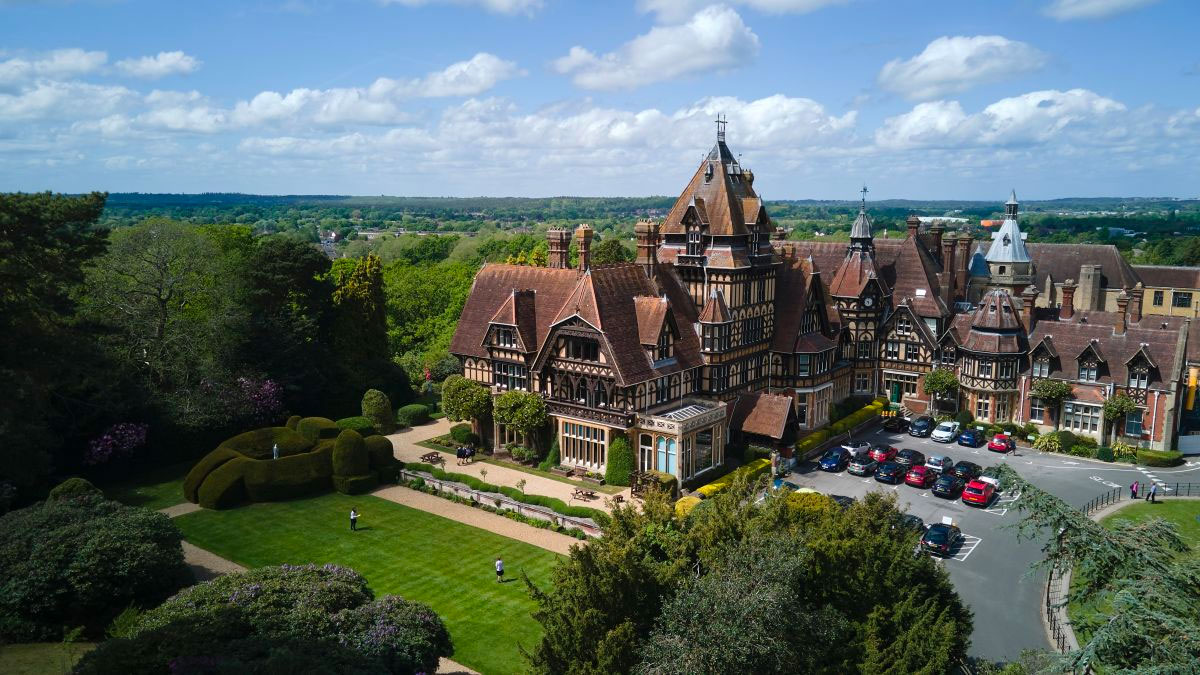
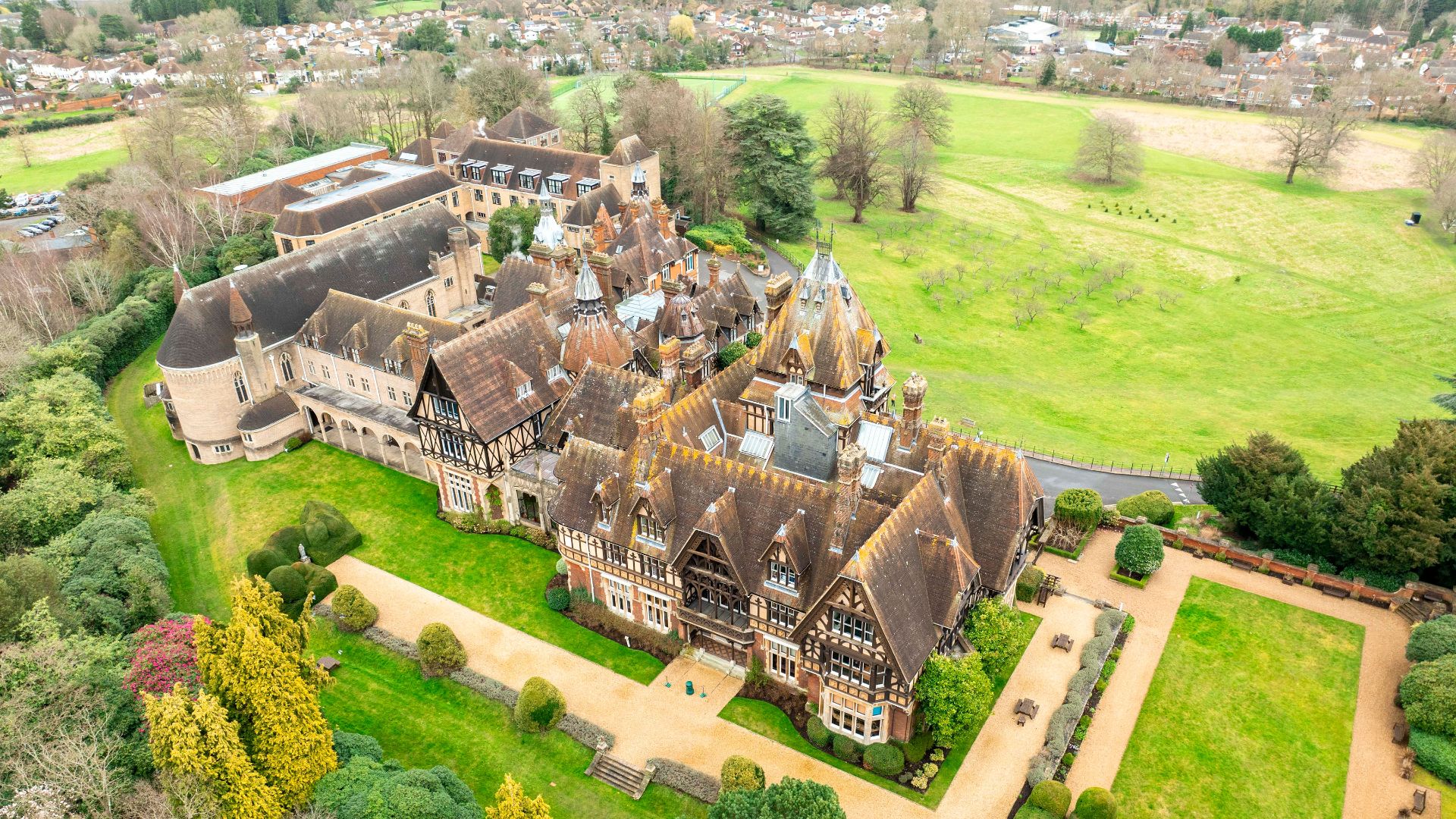
Thomas Longman, a fifth generation wealthy Victorian publisher, bought the Farnborough Hill site in 1860, after the death of The Dean. He relocated his new mansion, designed by HE Kendall, to the present hilltop site; the house was completed in 1863. His seals, the Ship and the Swan, can still be seen adorning the façade and the publishing company is still in business today, with a particular focus on educational textbooks. Thomas Longman, along with his younger brother William, was famed for his literary talent, editing a beautifully illustrated edition of the New Testament. Thomas' son, Thomas Norton Longman, took control of the firm, following the death of his father in 1879.
The exiled Empress Eugénie, widow of Emperor Napoleon III of France, bought the house from the Longmans in the late 19th century and, after a period of refurbishment and development to turn her ‘little country dwelling’ (as described in a letter to Queen Victoria, and noted in Queen Victoria's Journals) to a large home befitting her status as French Royalty, she moved in, living here from 1880 until her death in 1920. The Grand Salon, with its deep red walls, was one of the last rooms decorated by the Empress and has been carefully preserved by the school.
Crushed by the loss of her husband Napoleon III and the death in 1879 of her 23 year old son, the Prince Imperial, in the Zulu War, Empress Eugenie built St Michael’s Abbey as a monastery and Imperial Mausoleum. The Empress decreed that the trees between her Winter Garden (now part of our Library) and the Abbey should be maintained to allow her to see the final resting place of her beloved son and husband.
The Empress was an active member of the local community, visiting Hillside school (the former name of Farnborough Hill) and hosting pupils and other local residents in her gardens. During WWI, she opened her home as a hospital for recovering soldiers, funding their care and taking a keen interest in their recovery.
She passed away in 1920, aged 94, leaving her home and possessions to her nephew, Prince Victor Bonaparte. His subsequent death just six years later saw the house and grounds up for sale.
The School
The Religious of Christian Education (RCE) began in rural France when a forward-thinking local priest, Abbé Louis Lafosse, received an anonymous gift of 1000 francs to fund the training of four young women as teachers.
Marie-Anne Dutertre, Victoire Buisson, Marie-Louise Malhaire and Rose Gibory began their training under Abbé Lafosse, attending lessons in the evening so as not to be seen as competition for the classes given by local schoolmasters during the day. Together, the four young women decided that, in addition to becoming teachers, they wanted to dedicate their whole lives to God as sisters in a religious congregation and so they took their vows in the Church of St Andrew in Echauffour, Normandy, on 21 November 1817. The School celebrates the Sisters of the RCE on this date each year, known as Community Feast Day.
Staying true to their mission to bring education to young women, the order founded communities and schools at Echauffour in 1817, Argentan in 1818 and Remalard in 1826, before venturing further into the world. They arrived in Farnborough in 1889, opening Hillside Convent College which would later become Farnborough Hill.
Initially opening the school at Hillside (now Pinehurst Park on Farnborough Road), the pupil numbers grew rapidly and, following World War One (during which the building had been commissioned by the Army), Mother Roantree began to look for a new home for the boarders and Sisters. When Farnborough Hill came up for sale in 1927, she jumped at the chance to purchase it, and both nuns and boarding pupils moved in, travelling daily to Hillside to join the day pupils for their lessons.
School life changed in September 1939, when the Second World War was declared and Hillside was, once more, requisitioned by the Army. Mother Mostyn, the author of “The Story of a House”, a history of Farnborough Hill, records how little time they had to evacuate their well-equipped classrooms and move everything up to Farnborough Hill. Fortunately, the original house had been extended with the construction of the Refectory and Chapel (consecrated in 1932) and then the Hall and classrooms above. This meant that teaching could go on during the day uninterrupted, though ongoing air raids meant the boarders and nuns frequently had to sleep in the cellars.
After the war, Hillside was handed back to the Sisters, but by then the School had grown used to living and learning in one place and Hillside was sold. A substantial classroom block was built in the early 1950s and the Science department added in the 1960s, along with a gymnasium – which is now the Theatre on the Hill. Over the years there has been further expansion, including the addition of a swimming pool, the Sports Hall, St Cecilia’s music wing and, most recently the Lafosse Sixth Form Centre.
Girls continued to board at Farnborough Hill until the 1990s, when it became exclusively a day school.
In 2025, the School became a member of Historic Houses in recognition of the importance of the building's history.
To book a Tour on the Hill history tour, please visit our Box Office.
Click here to find out about volunteering to promote the heritage of Farnborough Hill.